
Guide
Cricket Bet Bangladesh: Markets, Data and Match Insights
Published 30 October 2026
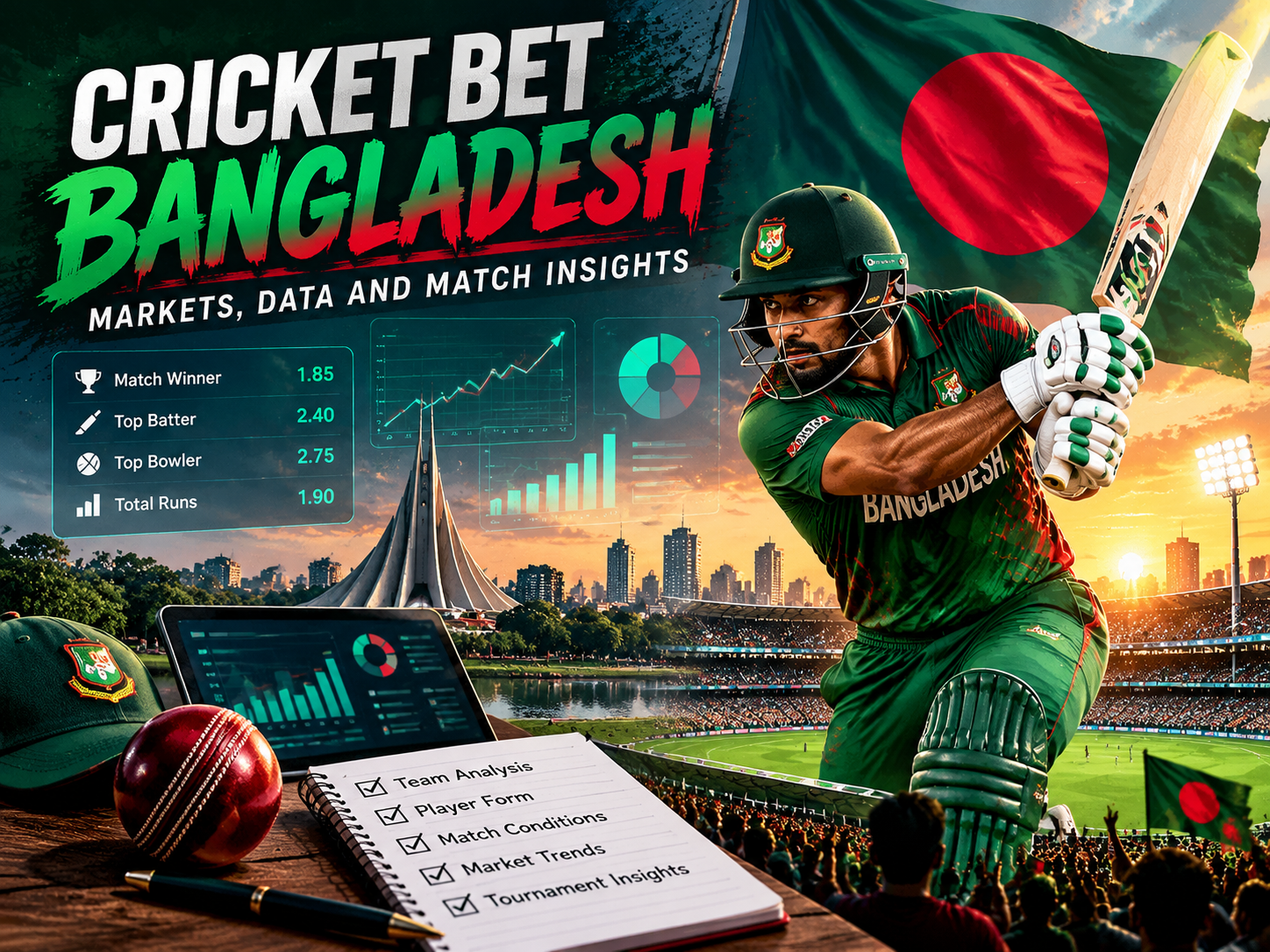
Cricket Bet Bangladesh: Markets, Data and Match Insights
Introduction
Cricket is more than a sporting competition in Bangladesh. It plays an important role in everyday entertainment, national identity and sporting discussions. From international fixtures to domestic tournaments, cricket attracts audiences who follow team performances, compare player statistics and explore upcoming matches.
Alongside this growing interest, the search phrase Cricket Bet Bangladesh connects readers with information about cricket-related markets, match outcomes, numerical odds and statistical concepts. However, understanding this subject requires more than knowing the possible results of a match. Readers also need to understand cricket formats, competition structures and the terminology that describes different sporting events.
Every cricket match contains several measurable elements. For instance, team scores, individual contributions, batting partnerships, bowling performances and tournament standings help explain how a competition develops.
This guide explores Cricket Bet Bangladesh from an informational perspective. In particular, it examines cricket market structures, match statistics, probability concepts and the differences between major cricket competitions.
Furthermore, readers can use this information to understand cricket terminology and the analytical language commonly associated with the sport.
The Relationship Between Cricket and Betting Markets in Bangladesh
Bangladesh has a large cricket-following audience. Supporters regularly discuss international matches, domestic competitions, emerging players and tournament performances.
Generally, cricket-related betting terminology describes different ways to represent possible sporting outcomes numerically.
A market refers to a defined category of possible outcomes connected with a sporting event. Its structure depends on the competition, match format and statistical event under consideration.
For example, cricket market descriptions may include:
The result of a complete match.
The team scoring the first innings.
The number of runs recorded by a batter.
Individual bowling performances.
Total runs during a specified period.
Tournament champion predictions.
The outcome of a particular innings.
Although these categories relate to the same sport, they describe different aspects of cricket. Therefore, readers should understand their definitions before interpreting cricket-related information.
Cricket’s Popularity and Its Influence on Sporting Discussions
The Bangladesh national cricket team has helped establish a strong following for international cricket. Matches against neighbouring countries and established international teams regularly generate discussions about team combinations, player form and match conditions.
Meanwhile, domestic competitions also contribute significantly to this sporting interest.
The Bangladesh Premier League introduces a franchise-based environment where supporters can compare different squads, overseas professionals and local cricket talent.
Additionally, other domestic competitions provide opportunities to examine longer-format performances and the development of emerging players.
As a result, cricket statistics, sporting markets and competition structures attract attention from different types of readers.
How Cricket Markets Are Structured
Cricket markets generally fall into several categories according to the events they measure. Understanding these categories makes it easier to interpret descriptions in cricket-related publications.
Match-Level Markets
Match-level markets concern the overall result of a particular fixture.
Typically, an international match involves two teams competing under a defined set of playing conditions. However, the possible outcomes depend on the format.
In limited-overs cricket, one team may win, both teams may finish with equal scores, or weather conditions may prevent a result.
Test cricket introduces another possibility: a draw.
Therefore, readers should always interpret match-result terminology according to the relevant competition rules.
Innings-Level Markets
An innings represents the period during which a team attempts to score runs.
In limited-overs cricket, each side generally receives a fixed allocation of overs. By contrast, Test cricket follows a different structure, allowing teams to bat until the opposition dismisses them or the captain declares the innings.
Innings-level statistics may include:
Total runs.
Wickets lost.
Overs completed.
Run rate.
Extras.
Batting partnerships.
Individual scores.
Together, these measurements provide a detailed picture of a team’s batting performance.
Individual Performance Markets
Some cricket-related categories focus on individual players rather than entire teams.
For example, batting and bowling contributions receive considerable attention.
Analysts describe a batter’s performance through runs, balls faced, boundaries and dismissal status. Similarly, they evaluate a bowler through wickets, overs, runs conceded and economy rate.
In addition, fielding statistics include catches, run-outs and stumpings.
These measurements help readers understand how individual contributions influence a team’s overall performance.
Tournament-Level Markets
Tournament-level categories concern an entire competition rather than one individual match.
For instance, the Bangladesh Premier League involves several franchises competing through an organised tournament structure.
Throughout the competition, teams play multiple fixtures and accumulate points. Depending on the tournament format, the final stages may include eliminators, qualifiers and a championship final.
Consequently, tournament-level analysis requires a broader perspective than a single-match comparison.
Understanding Probability in Cricket
Probability is a mathematical concept that describes how likely an event is to occur.
In cricket analysis, readers can use probability to discuss possible outcomes. Nevertheless, an estimated probability does not guarantee a particular result.
Consider a hypothetical example involving two teams.
Suppose an analytical model estimates the following possibilities:
| Possible outcome | Illustrative probability |
|---|---|
| Team A wins | 55% |
| Team B wins | 35% |
| Match ends without a winner | 10% |
| Total | 100% |
These figures are hypothetical and do not represent an actual Bangladesh cricket fixture.
Instead, they demonstrate how analysts can express possible outcomes as percentages.
What Is Implied Probability?
Implied probability represents a percentage calculated from numerical odds.
For decimal odds, the basic formula is:
Implied Probability = (1 / Decimal Odds) × 100
For example, decimal odds of 2.50 correspond to an implied probability of 40%.
However, this mathematical relationship does not establish the actual probability of a sporting event.
Furthermore, when a market contains multiple possible outcomes, their combined implied probabilities may exceed 100%. This difference can reflect the margin included in the displayed prices.
Why Probability Estimates Change
Cricket matches involve constantly changing conditions.
For example, an assessment made before the toss may differ from one made after the teams announce their playing XI.
Several other developments can also influence an assessment:
An unexpected player absence.
Changes in weather conditions.
A revised pitch assessment.
A major batting collapse.
An effective bowling spell.
A rain interruption.
A change in the match target.
As a result, analysts may revise their interpretations whenever new information becomes available.
A Closer Look at Cricket’s Major Playing Formats
The structure of a cricket competition directly influences its statistical characteristics.
Bangladesh supporters follow three major international formats. However, each format requires a different approach to understanding match data.
Test Cricket: Patience, Endurance and Long-Term Performance
Test cricket takes place over a maximum of five scheduled days.
Each side normally receives two innings. Consequently, this format provides an opportunity to examine long-term batting and bowling performances.
Important measurements include:
Batting average.
Bowling average.
Number of sessions survived.
Partnership duration.
Wickets taken.
Runs scored per session.
Match result and innings margin.
For example, a batter’s ability to remain at the crease for several hours can matter just as much as the number of runs scored.
Similarly, bowling analysis requires attention to workload, consistency and the ability to maintain pressure over extended periods.
One Day International Cricket: Balancing Scoring and Wickets
One Day International cricket follows a limited-overs structure of 50 overs per side under standard playing conditions.
This format combines controlled batting with opportunities for aggressive scoring.
Generally, teams manage their resources across three broad stages.
Opening phase: Batters establish the innings while taking advantage of fielding restrictions.
Middle phase: Teams maintain scoring momentum while attempting to preserve wickets.
Closing phase: Batters search for additional scoring opportunities during the final overs.
Therefore, effective ODI analysis examines how a team distributes its scoring throughout the innings rather than focusing exclusively on the final total.
T20 Cricket: Shorter Matches and Rapid Changes
T20 cricket provides 20 overs per team.
Because of its compact structure, individual performances can have a substantial influence on the final score.
Important T20 measurements include:
Runs scored during the first six overs.
Batting strike rate.
Boundary percentage.
Dot-ball frequency.
Bowling economy.
Wickets lost during the middle overs.
Final-over scoring.
A successful T20 innings often requires contributions from several batting positions.
Moreover, tactical decisions become particularly visible in this format. Changes in bowling combinations, batting order and field placement can influence the progression of an innings.
Bangladesh’s Cricket Landscape and Important Competitions
Understanding Cricket Bet Bangladesh also requires familiarity with the country’s cricket structure.
Several domestic and international competitions contribute to the development and popularity of the sport.
Bangladesh Premier League
The Bangladesh Premier League, commonly known as BPL, is a franchise-based T20 competition.
Its format brings together domestic cricketers and international professionals. Consequently, the tournament provides an opportunity to examine different team-building strategies, batting combinations and bowling resources.
BPL-related cricket discussions frequently cover:
Franchise squad composition.
Overseas player participation.
Local emerging talent.
Batting order decisions.
Bowling combinations.
Competition standings.
Knockout-stage performances.
Since BPL follows a T20 format, statistics such as strike rate, economy rate and powerplay scoring receive particular attention.
National Cricket League
The National Cricket League forms part of Bangladesh’s first-class domestic cricket structure.
It gives players an environment to develop their longer-format batting and bowling abilities.
Unlike a short franchise competition, first-class cricket allows analysts to examine sustained performance across extended innings and multiple days.
Bangladesh Cricket League
The Bangladesh Cricket League also contributes to the country’s domestic first-class cricket environment.
It provides opportunities for leading domestic players to compete in a structured competition.
Furthermore, longer-format performances help observers examine consistency, technical ability and player development.
Dhaka Premier Division Cricket League
The Dhaka Premier Division Cricket League contributes to domestic one-day cricket.
It also supports the local cricket environment by providing opportunities for club-level competition.
Women’s Cricket in Bangladesh
Bangladesh women’s cricket plays an important role in the country’s sporting development.
International matches and domestic competitions provide opportunities to examine individual performances, team development and competition standards.
Importantly, analysts should evaluate women’s cricket through its own match data, playing conditions and competition structure rather than automatically applying assumptions from men’s competitions.
The Role of Team Composition in Match Analysis
A cricket team combines several specialist roles. Understanding these responsibilities helps explain how different teams approach a fixture.
Opening Batters
Opening batters begin an innings and face the initial bowling attack.
Their responsibilities vary according to the format.
In T20 cricket, they may attempt to establish a fast scoring rate. However, Test match openers often concentrate on negotiating the new ball and providing a stable beginning.
Middle-Order Batters
Middle-order players provide flexibility during different stages of an innings.
For example, they may rebuild after early wickets, maintain scoring momentum or accelerate during the closing overs.
Analysts evaluate their contributions through batting averages, strike rates and performances under different match conditions.
All-Rounders
All-rounders contribute through both batting and bowling.
Consequently, their presence gives team management additional tactical options.
However, their responsibilities vary. Some players primarily contribute with the bat and bowl occasionally, while others provide a more substantial bowling contribution.
Specialist Bowlers
Fast bowlers, swing bowlers and spin bowlers perform different functions.
Fast bowlers generally focus on pace, movement and short-pitched deliveries. Meanwhile, spin bowlers use variations in flight, turn and pace to challenge batters.
Therefore, specialist bowling roles remain important when analysts evaluate team balance.
Wicketkeepers
Wicketkeepers contribute through catches, stumpings and communication with bowlers.
Additionally, their batting ability can influence the overall composition of a team.
How to Read a Cricket Scorecard Correctly
A cricket scorecard contains much more information than the final result.
Therefore, learning to interpret its different sections provides a practical foundation for understanding match performance.
Consider this hypothetical ODI innings:
| Batter | Runs | Balls |
|---|---|---|
| Batter A | 72 | 65 |
| Batter B | 38 | 44 |
| Batter C | 51 | 48 |
| Batter D | 24 | 19 |
| Other batters | 35 | 30 |
| Extras | 15 | – |
| Total | 235 | – |
The total combines the batters’ contributions with the extras.
Additionally, a scorecard identifies how each batter lost their wicket and provides details about individual bowling performances.
Understanding Extras
Extras represent runs that the scorekeeper does not credit directly to an individual batter.
Common types include:
Wides.
No-balls.
Byes.
Leg-byes.
Penalty runs.
These categories contribute to the team total. Furthermore, they influence the calculation of individual bowling figures.
Reading Bowling Figures
Bowling figures usually display the overs bowled, maidens, runs conceded and wickets taken.
For example, the figures 4-0-28-2 represent:
Four overs bowled.
Zero maiden overs.
Twenty-eight runs conceded.
Two wickets taken.
Consequently, readers can use this notation to understand a bowler’s contribution without examining every delivery individually.
Technology and Data in Modern Cricket Analysis
Cricket has become increasingly data-driven. Today, modern broadcasts and statistical platforms provide information that ordinary supporters once found difficult to access.
Ball-by-Ball Data
Ball-by-ball information records events from individual deliveries.
For example, this information may include:
Runs scored.
Wickets.
Extras.
Delivery type.
Batter response.
Bowler identity.
Over progression.
As a result, analysts can reconstruct the development of an innings and examine important moments in greater detail.
Wagon Wheels
A wagon wheel provides a graphical representation of the directions in which a batter scores runs.
It helps illustrate scoring preferences and the distribution of shots around the ground.
Pitch Maps
Pitch maps display the locations where deliveries land on the playing surface.
Therefore, analysts can use them to examine a bowler’s length, line and consistency.
Heat Maps
Heat maps use visual patterns to represent the concentration of particular events.
In cricket, they may illustrate batting scoring areas, delivery locations or fielding activity.
Performance Dashboards
Cricket dashboards combine multiple statistical measurements within a single interface.
A typical dashboard may include batting performance, bowling figures, team totals and match progression.
Consequently, these visualisations make complex cricket information easier to interpret.
Common Mistakes in Cricket Data Interpretation
Even experienced cricket followers can misunderstand statistics when they separate them from their original context.
Several common mistakes deserve attention.
Comparing Different Formats Without Adjustment
A batting strike rate of 85 may have a different meaning in Test cricket than in T20 cricket.
This happens because each format has different scoring expectations.
Therefore, performance comparisons should account for match duration, playing conditions and competition requirements.
Treating Historical Records as Current Performance
Historical head-to-head statistics provide useful background information.
However, teams change over time. Players retire, new talents emerge and coaching strategies evolve.
Consequently, older records should not automatically represent current team strength.
Ignoring the Quality of Opposition
A player may produce impressive numbers against one group of opponents and different results against another.
For this reason, opposition quality remains an important part of performance evaluation.
Focusing Only on Individual Scores
Cricket is a team sport. Therefore, readers should consider an individual score alongside partnerships, match situations and the team’s overall performance.
For example, a batter scoring 80 runs may deliver a valuable innings. Nevertheless, readers should examine the target, pitch conditions and contributions from other players before interpreting that performance.
Overlooking Match Conditions
Rain, dew, pitch behaviour and ground dimensions can influence scoring patterns.
For example, conditions at one venue may differ considerably from those at another.
As a result, statistical comparisons become more meaningful when analysts consider the conditions surrounding each performance.
Useful Online Resources for Bangladesh Cricket Research
Readers interested in cricket statistics and tournament information can consult established cricket organisations and sports databases.
Bangladesh Cricket Board: The BCB provides information about national teams, domestic competitions and official cricket announcements.
Website: https://www.tigercricket.com.bd/
International Cricket Council: The ICC offers international tournament information, rankings, playing regulations and cricket development resources.
Website: https://www.icc-cricket.com/
ESPNcricinfo: This platform provides match reports, historical scorecards, player profiles and cricket statistics.
Website: https://www.espncricinfo.com/
Cricbuzz: Readers can explore cricket scores, match commentary, schedules and sporting news through this platform.
Website: https://www.cricbuzz.com/
Howstat: This database offers historical cricket statistics and records across different formats.
Website: https://www.howstat.com/
Furthermore, consulting multiple established sources helps readers distinguish official match information from statistical interpretation and general commentary.
Frequently Asked Questions About Cricket Bet Bangladesh
1. What information is covered by Cricket Bet Bangladesh?
Cricket Bet Bangladesh is a search term associated with cricket-related betting terminology, match markets, numerical odds and statistical information relevant to Bangladeshi cricket audiences.
2. How are cricket markets categorised?
Readers can organise cricket markets into match-level, innings-level, player-level and tournament-level categories. Each category describes a different sporting outcome or performance measurement.
3. What is the difference between a cricket market and a match prediction?
A cricket market defines a category of possible outcomes. In contrast, a prediction represents an expectation about which outcome may occur based on available information and analysis.
4. Why is probability important in cricket analysis?
Probability provides a mathematical framework for expressing the likelihood of possible outcomes. However, it cannot guarantee the final result of a cricket match.
5. What is the significance of player statistics in cricket?
Player statistics provide measurable information about individual contributions. For instance, batting averages, strike rates, bowling economy and wicket counts help describe different aspects of performance.
6. How does the BPL differ from international cricket?
The Bangladesh Premier League is a franchise-based domestic T20 competition. Meanwhile, international cricket involves national teams competing under international governing-body regulations.
7. What information does a cricket scorecard provide?
A scorecard records team totals, individual runs, wickets, overs, extras, bowling figures and other match information. Therefore, readers can use it to understand the innings and match progression.
8. How do weather conditions affect cricket statistics?
Rain may reduce available playing time, while humidity, wind and dew can influence playing conditions. Consequently, these factors may affect scoring patterns and bowling performance.
9. What is the difference between batting average and strike rate?
Batting average measures runs scored per dismissal, whereas strike rate measures runs scored per 100 balls faced. Both measurements describe different aspects of batting performance.
10. Where can Bangladesh cricket statistics be researched?
Readers can explore the Bangladesh Cricket Board, ICC, ESPNcricinfo, Cricbuzz and Howstat. These resources provide match information, player records and cricket statistics.
Final Thoughts
Cricket Bet Bangladesh covers a broad informational subject that connects sporting terminology, statistical interpretation and cricket-related market descriptions.
To understand this subject properly, readers should first learn how different cricket formats operate. In addition, team structures, individual player contributions and tournament rules help explain how sporting events develop.
Bangladesh offers a diverse cricket environment. Supporters can follow international fixtures, franchise competitions, first-class tournaments and women’s cricket throughout different stages of the sporting calendar.
Furthermore, learning to interpret scorecards, understand probability and compare player performances creates a stronger foundation for exploring cricket-related information.
Ultimately, reliable statistical sources and clearly defined terminology help readers develop a more informed understanding of the sport. Accurate information also provides a stronger basis for interpreting cricket discussions than unsupported assumptions or isolated numerical comparisons.
Keep reading
Related guides

Guide
9Wickets for Android: Features, Access and Setup Guide
9Wickets for Android: Complete App and Mobile Access GuideIntroductionSearching for 9Wickets for Android usually means looking for information about accessing the 9Wickets platform on…
Read the guide →
Guide
Ninewicket Crickets Bet: Online Cricket Betting Guide
Ninewicket Crickets Bet: A Complete Guide to Cricket Betting BasicsCricket attracts millions of fans who follow international fixtures, domestic competitions, and major tournaments throughout…
Read the guide →
Guide
Ninewickets Site: Guide to Website Features, Safety and FAQs
Ninewickets: A Complete Guide to Website Features, Safety and FAQs Introduction Ninewickets site is a name associated with online sports information, cricket-related content, sports…
Read the guide →Ready to put this guide to work?
Open a 9Wickets account with bKash, Nagad or Rocket, or talk to support if you need a hand.