
Guide
9Wickets API Explained: Integration, Data Access, Security and Developer Guide
Published 16 August 2026
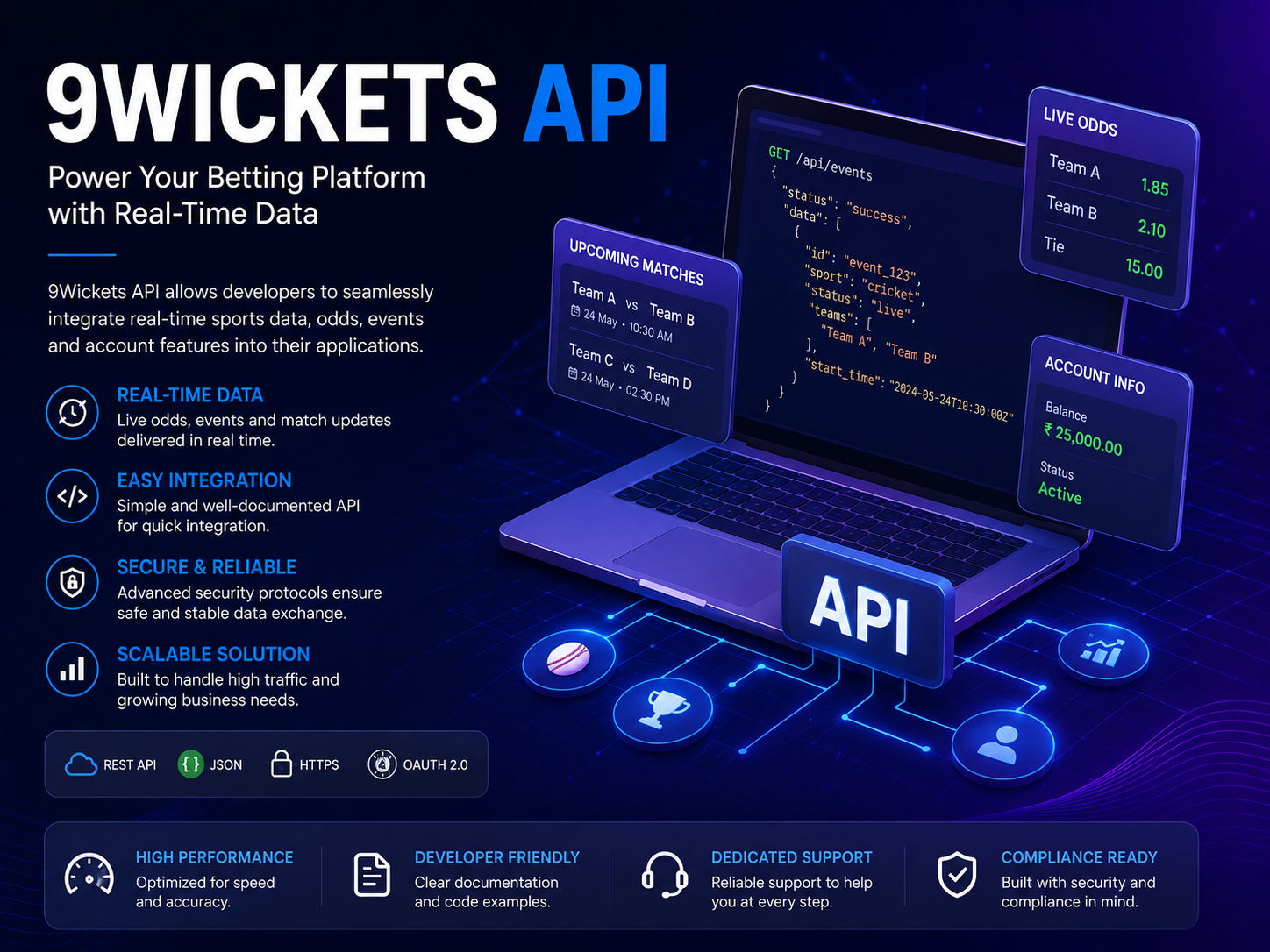
9Wickets API: Complete Guide to Integration, Authentication, Data, Security, and API Access
Introduction
Digital sports platforms increasingly rely on APIs to connect different software systems. An application programming interface creates a structured communication channel between an external application and a service provider. Instead of transferring information manually, software can request, receive, and process data automatically.
The term 9Wickets API can describe an API or technical integration associated with the 9Wickets ecosystem. Developers may search for this type of interface when researching sports data, event information, betting markets, account services, or other platform-related functionality.
However, developers should clarify one important point from the beginning. API capabilities depend on the service provider. Therefore, an endpoint that appears on a third-party website does not automatically represent an official API. In addition, access may depend on approval, commercial agreements, account permissions, geographic availability, and technical restrictions.
This guide explains how a betting-related API generally works. It also covers authentication, data exchange, endpoint structures, security, caching, error handling, testing, and compliance considerations. As a result, developers can better understand what they should verify before starting an integration project.
What Does 9Wickets API Mean?
An API acts as an intermediary between software applications. It allows one system to request information or perform an authorized operation through another system.
For example, imagine that a developer wants to build a sports information dashboard. The dashboard needs competition and match information. Instead of entering every event manually, the application can communicate with an authorized API and receive structured data.
The basic process looks like this:
Application
     ↓
API Request
     ↓
Remote Server
     ↓
API Processing
     ↓
Structured Response
     ↓
Application
The server may return information in JSON, XML, or another supported format.
A 9Wickets-related API could potentially provide selected platform data or functionality to authorized applications. However, developers should verify the official documentation before assuming that a particular endpoint, field, or service exists.
Therefore, developers should treat third-party API information as unverified until an authorized source confirms it.
Why API Integration Is Important
Modern online platforms rarely operate as isolated applications. Instead, they usually connect several systems that exchange information continuously.
A typical sports platform can include:
-
Web applications
-
Mobile applications
-
Backend servers
-
Sports data providers
-
Authentication systems
-
Payment services
-
Customer databases
-
Reporting systems
-
Analytics platforms
-
Notification services
APIs allow these components to exchange information efficiently.
For instance, a frontend application can request event information from a backend service. The backend can then communicate with an external API and return only the required information to the frontend.
This approach offers several advantages. First, it separates sensitive backend processes from the public interface. Second, it gives developers greater control over data processing. Finally, it can make future application changes easier.
Potential Data Categories
The exact information available through an API varies significantly between providers. Some services offer extensive sports data, while others expose only a limited number of endpoints.
Therefore, developers should always review the official documentation before designing an application around specific fields.
Sports Information
A sports API may provide information about different sports and competitions.
Potential fields can include:
-
Sport identifier
-
Sport name
-
Competition identifier
-
Competition name
-
Event identifier
-
Event name
-
Start time
-
Event status
-
Participant information
Developers can use this information to organize events inside an application. Furthermore, structured identifiers can help the application connect related information across different screens.
Match Information
Match-level information can help applications display upcoming or active sporting events.
Depending on the provider, an API may return:
-
Teams or participants
-
Match schedule
-
Competition
-
Start date
-
Start time
-
Current status
-
Result status
However, event information can change over time. Therefore, applications should process status updates carefully and avoid relying indefinitely on old responses.
Market Information
A betting market represents a particular category associated with a sporting event.
Depending on the authorized API, available information may include:
-
Market identifier
-
Market name
-
Selection identifier
-
Selection name
-
Market status
-
Availability
-
Pricing information
The provider determines the exact structure. Consequently, developers should use the documented fields instead of assuming that every API follows the same format.
Odds Information
Odds can change much more frequently than static sports information. Therefore, applications that process odds require careful data-handling strategies.
If an authorized API provides odds, the application may need to handle situations where:
-
Odds change
-
A market becomes suspended
-
A selection becomes unavailable
-
This is An event starts
-
An event gets postponed
-
An event gets cancelled
For this reason, developers should distinguish current information from cached information. Otherwise, an application could display outdated data.
API Authentication
Authentication determines whether an application can communicate with an API.
Different providers use different authentication methods. Therefore, developers should follow the exact method described in the provider’s documentation.
API Key Authentication
An API key identifies an application or account. The application may send the key through an HTTP header when it makes a request.
For example:
X-API-Key: YOUR_API_KEY
Developers should never expose private API keys through public frontend code. Instead, they should store sensitive credentials securely on the server.
Bearer Tokens
Many modern APIs use access tokens.
A simplified request can look like this:
Authorization: Bearer YOUR_ACCESS_TOKEN
The server can use the token to determine whether the application has permission to access a specific resource.
Because tokens may expire, applications should also support the provider’s approved renewal or authentication process.
OAuth
Some modern systems use OAuth-based authorization. OAuth can provide controlled access without requiring an application to store a user’s primary password.
However, OAuth implementations can differ between providers. Therefore, developers should follow the official authorization flow rather than copying an unrelated implementation.
Why Authentication Matters
Authentication does more than confirm a user’s identity. A professional API system can use authentication to control several aspects of access.
For example, the system can determine:
-
Who can access the API
-
Which endpoints the application can use
-
How much data the application can retrieve
-
Which operations the application can perform
-
When access should expire
-
Is a Whether administrators have revoked credentials
Therefore, developers should always use the authentication process that the provider officially recommends.
Getting API Access
Before writing integration code, developers should determine whether official API access exists.
A sensible process includes several steps.
1. Identify the Required Function
First, determine exactly what the application needs.
For example, the project may require:
-
Sports schedules
-
Event data
-
Market information
-
Odds
-
Account data
-
Transaction information
-
Reporting data
Defining the requirement first makes the integration more focused. It also prevents developers from requesting unnecessary permissions.
2. Verify Official Availability
Next, check whether the service provides an official developer program, API documentation, partner access, or technical support.
If public documentation does not exist, contact an authorized representative for clarification.
Most importantly, do not assume that an API endpoint listed on a random website represents an official service.
3. Review Access Conditions
API access may involve conditions related to:
-
Account type
-
Commercial use
-
Request volume
-
Geographic availability
-
Data redistribution
-
Branding
-
Security
-
Licensing
Therefore, developers should review these conditions before they begin development.
4. Obtain Credentials Securely
After the provider approves access, store the credentials securely.
For example, developers can use environment variables or dedicated secret-management systems. They should never publish private credentials inside public repositories or unsecured messages.
Understanding API Endpoints
An API usually exposes multiple endpoints. Each endpoint represents a specific resource or operation.
For example, a hypothetical sports API could use endpoints such as:
GET /events
GET /competitions
A GET /markets
GET /events/{event_id}
These examples only demonstrate common API design concepts. They do not represent confirmed 9Wickets endpoints.
Each endpoint may define its own:
-
Parameters
-
Authentication requirements
-
Response format
-
Permission level
-
Request limit
Therefore, developers should rely on the official endpoint definitions provided by the service.
HTTP Methods Used by APIs
Modern REST-style APIs commonly use several HTTP methods.
GET
Developers generally use GET requests to retrieve information.
Example:
GET /events
POST
Applications commonly use POST requests when they need to send information to a server.
Example:
POST /account/action
PUT
Developers can use PUT to replace or update a resource, depending on the API design.
PATCH
PATCH usually handles partial updates.
DELETE
DELETE requests can remove resources when the API supports that operation.
The provider ultimately determines which methods an application can use.
JSON Responses
JSON remains one of the most common formats for modern APIs.
A simplified response might look like this:
{
  "success": true,
  "event": {
    "id": "example_001",
    "sport": "cricket",
    "status": "scheduled"
  }
}
Again, this example only demonstrates a possible structure. It does not represent an actual 9Wickets response.
A real API response may contain many fields, nested objects, arrays, timestamps, status codes, and metadata.
Therefore, developers should build applications around the documented response structure. They should also avoid assuming that undocumented fields will remain available permanently.
Handling API Responses
Receiving data represents only one part of API integration. The application must also interpret the response correctly.
A robust implementation should check:
-
HTTP status
-
Response body
-
Required fields
-
Data types
-
Timestamp
-
Status information
-
Error messages
For example, an HTTP 200 response does not automatically guarantee that every expected field contains valid information.
Therefore, applications should validate external data before they use it.
This approach can prevent unexpected values from reaching users or affecting other application processes.
API Error Handling
Errors naturally occur in API-based systems. A request can fail for many different reasons.
Common causes include:
-
Invalid authentication
-
Missing parameters
-
Incorrect endpoint
-
Insufficient permission
-
Excessive requests
-
Network problems
-
Server errors
-
Temporary maintenance
For this reason, developers should design error-handling procedures before production deployment.
Authentication Failure
When credentials become invalid or expire, the application should stop sending repeated requests with the same invalid credentials.
Instead, it should follow the provider’s documented authentication or renewal process.
Validation Error
If the server rejects incorrect parameters, the application should identify the problem and correct the request.
Repeatedly sending the same invalid request can waste resources and may trigger additional restrictions.
Rate Limit Response
When the provider limits request frequency, the application should reduce its request rate.
In addition, developers should follow any retry or backoff instructions provided by the API.
Server Failure
Temporary server failures may justify a limited retry strategy.
However, the application should avoid sending unlimited retries. Instead, it should use controlled delays and stop after a reasonable number of attempts.
Rate Limits and Request Management
API providers often impose request limits. These limits protect infrastructure and help prevent one application from consuming excessive resources.
For example, suppose an application requests the same information every second even though that information changes only occasionally. Such behavior can generate unnecessary traffic.
Developers can improve efficiency through:
-
Caching
-
Request queues
-
Controlled polling
-
Backoff strategies
-
Appropriate refresh intervals
Most importantly, developers should never attempt to bypass API rate limits.
A well-designed application should work within the limits provided by the service.
Caching Strategy
Caching can reduce API usage while improving application performance.
For example, competition names and historical information may not require constant updates. Therefore, an application can sometimes cache this type of data for an appropriate period.
However, developers should apply greater caution to highly dynamic information.
A useful question is:
How old can this information become before it starts misleading users?
The answer depends on the type of data.
Static information may tolerate longer cache periods. In contrast, event schedules, market availability, and rapidly changing pricing may require much shorter refresh intervals.
Developers should also confirm that the API provider allows caching and data storage.
Webhooks and Real-Time Notifications
APIs can use several methods to deliver updates.
Traditional polling works like this:
Application
    ↓
Request update
    ↓
Receive response
    ↓
Wait
    ↓
Request again
A webhook works differently:
Event occurs
    ↓
Service sends notification
    ↓
Application receives notification
    ↓
Application processes update
If the API provider supports webhooks, they can reduce unnecessary polling.
However, developers should secure webhook endpoints properly. The application should verify that incoming notifications are legitimate before it processes them.
Backend Architecture
One of the most important decisions involves determining where API communication should occur.
A common architecture looks like this:
User
 ↓
Website or Mobile App
 ↓
Application Backend
 ↓
API Integration Service
 ↓
Authorized External API
This architecture offers several advantages.
The backend can:
-
Protect credentials
-
Validate requests
-
Transform data
-
Cache responses
-
Apply access controls
-
Monitor failures
-
Control API usage
For example, if developers place private API credentials directly inside public website code, users may discover those credentials.
Therefore, sensitive API communication should normally remain on a secure backend whenever the integration requires private credentials.
Mobile App Integration
Mobile applications can consume API data, but developers should carefully manage credentials.
Attackers can inspect or reverse-engineer mobile applications more easily than protected server-side systems.
For sensitive integrations, developers often prefer an architecture like this:
Mobile App
    ↓
Secure Backend
    ↓
External API
The mobile application then communicates with the developer’s backend. The backend handles the private API credentials and communicates with the external service.
This design can provide better control over authentication, access permissions, logging, and request management.
Security Best Practices
Security should remain part of the development process from the beginning.
Use HTTPS
Developers should use encrypted HTTPS connections for API communication.
Protect Secrets
Store API keys, tokens, and private credentials through appropriate secret-management mechanisms.
Apply Least Privilege
Give each application only the permissions it actually needs.
Rotate Credentials
If the provider supports credential rotation, replace credentials according to an appropriate security policy.
Validate Inputs
Applications should never assume that user-generated values are safe.
Monitor Access
Unusual request patterns can indicate credential theft, configuration problems, or other security issues.
Avoid Sensitive Logs
Developers should not place passwords, access tokens, private keys, or other confidential information in ordinary application logs.
Payment-Related Integration
Payment functionality requires additional security and careful authorization.
If an API provides transaction-related information, developers should understand the applicable authorization and verification requirements.
Potential categories may include:
-
Transaction status
-
Deposit information
-
Withdrawal status
-
Account records
-
Verification results
-
Payment references
Financial operations require careful validation. Applications should also avoid storing sensitive payment information unless they have a legitimate and compliant reason to do so.
Furthermore, developers should review the relevant payment, privacy, and regulatory requirements before launching financial functionality.
Data Privacy
API integrations can involve personal information. Depending on the service and application, the data may include:
-
Account identifiers
-
Contact information
-
Transaction records
-
Authentication data
-
Activity information
Developers should understand the privacy requirements that apply to their project and the provider’s data-processing rules.
In addition, applications should collect and retain information only when necessary for the intended purpose.
Proper access controls can also prevent unauthorized users from viewing private information.
API Versioning
External APIs can change over time.
For example, a provider may introduce:
-
New endpoints
-
New fields
-
Deprecated endpoints
-
Changed authentication
-
New response structures
-
Updated security requirements
API versioning can reduce compatibility problems.
For example, an API might distinguish between:
/api/v1/
and:
/api/v2/
These paths only illustrate a common versioning approach.
Developers should use the version that the provider officially supports. They should also monitor documentation for deprecation notices and migration requirements.
Testing an API Integration
Developers should test both successful and unsuccessful scenarios before production deployment.
Functional Testing
Verify that valid requests return the expected information.
Authentication Testing
Confirm that the system rejects unauthorized requests.
Error Testing
Test invalid parameters, unavailable services, and other expected failure conditions.
Performance Testing
Measure response times under realistic workloads.
Security Testing
Check whether credentials and sensitive information remain protected.
Recovery Testing
Determine how the application behaves when the external service becomes temporarily unavailable.
Testing these scenarios can expose problems before real users encounter them.
Monitoring in Production
After deployment, monitoring becomes essential.
Useful metrics include:
-
API response time
-
Successful requests
-
Failed requests
-
Authentication errors
-
Rate-limit responses
-
Timeout frequency
-
Service availability
Developers can also create alerts for unusual changes.
For example, a sudden increase in authentication failures may indicate expired credentials or a configuration problem. Similarly, a sharp increase in timeouts may indicate an external service issue.
Therefore, monitoring can help teams identify problems before they affect a large number of users.
Advantages of API Integration
A properly authorized API can provide several technical benefits.
Automation
Applications can process information automatically instead of relying on manual data entry.
Consistency
Structured API data can reduce inconsistencies caused by manual updates.
Efficiency
Backend systems can retrieve only the information required for a specific operation.
Scalability
A well-designed integration can support increasing application traffic when the provider allows the required capacity.
Flexible Applications
A single backend integration can potentially support web applications, mobile applications, dashboards, and internal tools.
Better Data Processing
Structured responses can feed dashboards, reports, analytics systems, and other application features.
Limitations to Consider
API integration also creates several challenges.
Potential limitations include:
-
Restricted access
-
Request limits
-
Changing documentation
-
Temporary outages
-
Data delays
-
Limited historical information
-
Commercial restrictions
-
Geographic limitations
-
Permission changes
Therefore, developers should plan for these situations before launching a production application.
A reliable integration should include error handling, monitoring, fallback behavior, and clear documentation.
Official API Versus Third-Party Solutions
This distinction matters when researching 9Wickets API information.
An official API comes directly from, or receives authorization from, the relevant service.
A third-party API may obtain or redistribute information through another service.
This is a unofficial endpoint may lack authorization or long-term stability.
Relying on an unofficial integration can create several risks, including:
-
Unexpected shutdown
-
Incorrect information
-
Security vulnerabilities
-
Unclear data rights
-
Compatibility problems
-
Account restrictions
For commercial applications, developers should generally prioritize official and authorized access.
Is There a Public 9Wickets API?
Developers should not assume that a public developer API exists simply because websites, forums, or other online sources mention one.
API access can remain private, partner-based, restricted, or unavailable to general developers.
Before starting a project, developers should verify:
-
Official documentation
-
Developer registration
-
Supported endpoints
-
Authentication method
-
Usage limits
-
Commercial conditions
-
Data usage permissions
-
Geographic restrictions
If developers cannot confirm these details through an authoritative source, they should avoid presenting third-party information as official documentation.
This distinction becomes especially important when a project involves commercial use, user accounts, payments, or sensitive information.
How to Choose an API for a Project
When evaluating an API for a software project, developers should consider several factors.
Documentation Quality
Good documentation should clearly explain endpoints, parameters, authentication, responses, status codes, and errors.
Clear documentation can reduce development time and prevent implementation mistakes.
Reliability
Production applications need predictable service availability. Therefore, developers should evaluate the provider’s reliability before depending on the API.
Data Accuracy
The API should provide sufficiently accurate and timely information for the application’s purpose.
Response Speed
Slow API responses can negatively affect user experience. Developers should therefore consider latency during testing.
Security
Authentication, encryption, credential management, and access controls should meet modern security expectations.
Support
Technical support can become important when developers encounter unexpected integration problems.
Cost
Commercial API programs may involve usage fees, subscription charges, or contractual arrangements.
Developers should understand the pricing model before committing to the integration.
Legal Compatibility
The intended use should comply with applicable laws, regulations, licensing requirements, and provider policies.
Common Developer Mistakes
Several mistakes occur frequently during API projects.
Hard-Coding Credentials
Putting API keys directly into source code increases the risk of accidental exposure.
Instead, developers should use secure configuration and secret-management practices.
Ignoring Error Responses
Applications should not assume that every request will succeed.
Instead, they should inspect response codes and handle expected errors appropriately.
Excessive Polling
Repeatedly requesting identical information can consume unnecessary API quota.
Developers should use caching or suitable refresh intervals whenever the provider permits them.
No Timeout
An application should not allow external requests to wait indefinitely.
Instead, developers should configure reasonable timeout values.
Poor Logging
Insufficient logging can make production troubleshooting difficult.
At the same time, developers should avoid recording sensitive credentials or personal information in logs.
Overly Broad Permissions
Applications should request only the access they actually need.
This approach follows the principle of least privilege and can reduce potential security risks.
Depending on Undocumented Behavior
If an endpoint or response field does not appear in official documentation, developers should avoid depending on it for critical functionality.
Undocumented behavior can change without warning.
Recommended Development Workflow
A practical API integration workflow can follow these stages:
Define Requirements
        ↓
Verify Official API Access
        ↓
Read Documentation
        ↓
Obtain Authorized Credentials
        ↓
Create Test Environment
        ↓
Build Integration
        ↓
Validate Responses
        ↓
Implement Security
        ↓
Add Monitoring
        ↓
Production Deployment
First, define the application’s requirements. Next, verify that the provider actually offers the required API access.
After that, study the official documentation and obtain authorized credentials. Then build and test the integration in a controlled environment.
Once the integration works correctly, add security controls, monitoring, error handling, and rate-limit management.
Finally, move the application into production after completing functional, performance, and security testing.
Frequently Asked Questions
What is the purpose of a 9Wickets API?
A 9Wickets-related API could potentially allow authorized software to communicate with supported platform services or retrieve available information. However, its actual purpose depends on the endpoints and permissions that the provider makes available.
Can developers access 9Wickets API data directly?
Access depends on whether the provider offers an official API and what permissions it grants. Therefore, developers should confirm availability through an authorized source before beginning development.
What information can an API provide?
Depending on the service, an API may provide sports information, competitions, events, markets, pricing, account information, or transaction status. However, developers must verify the actual availability through official documentation.
Is an API key required?
Many APIs require an API key, access token, OAuth credential, or another authentication method. The exact requirement depends on the provider.
Can an API work with WordPress?
Yes. WordPress can communicate with external APIs through PHP, custom code, or suitable plugins.
However, developers should store sensitive credentials securely. They should also avoid exposing private keys through public frontend code.
Python connect to a betting API?
Yes. Python provides libraries and tools for sending HTTP requests and processing JSON responses.
However, the application still needs valid authorization and accurate API documentation.
Can JavaScript be used for API integration?
Yes. Developers widely use JavaScript and TypeScript for API-based applications.
However, sensitive credentials should generally remain on a secure backend rather than inside publicly accessible browser code.
How should API credentials be stored?
Developers should keep credentials outside public source code. Environment variables, secret-management platforms, and other secure mechanisms can help protect sensitive access information.
What should developers do when an API returns an error?
The application should inspect the response, identify the error category, record appropriate diagnostic information, and apply a controlled recovery strategy when appropriate.
For example, temporary server errors may require limited retries, while invalid authentication may require credential renewal.
Are unofficial APIs reliable?
Reliability varies between services. However, unofficial APIs can create additional risks because their availability, security, data quality, authorization, and long-term stability may remain uncertain.
For production projects, developers should therefore prefer officially supported integrations whenever possible.
Conclusion
The 9Wickets API topic primarily concerns technical integration between software applications and an external platform or service. APIs can help applications communicate with remote systems and process structured information automatically.
Depending on the authorized functionality, a betting-related API could potentially involve sports events, market information, account services, transactions, or other platform data.
However, developers should not assume that every endpoint found online represents an official or publicly available API. Providers may restrict API access through technical requirements, commercial agreements, contractual terms, geographic limitations, or regulatory conditions.
A reliable integration should begin with official documentation and authorized credentials. From there, developers can implement secure authentication, backend-based credential management, input validation, response checking, rate-limit handling, appropriate caching, monitoring, and controlled error recovery.
Furthermore, projects involving betting-related information may require additional attention to privacy, responsible-use requirements, licensing obligations, advertising rules, and other applicable regulations.
Ultimately, the safest development approach remains straightforward:
Verify the API, understand its permissions, protect credentials, respect usage limits, validate the data, and build only around officially supported functionality.
Keep reading
Related guides

Guide
NineWickets Site in BD: A Complete Online Cricket Resource Guide
NineWickets Site in BD: A Complete Online Cricket Resource Guide Introduction Cricket has become more than just a sport in Bangladesh. It is a…
Read the guide →
Guide
Bangladesh 9Wickets Bet Guide: Platform Overview, Features and Safety Tips
Bangladesh 9Wickets Bet: Platform Overview, Features and Safety Guide Introduction Online betting platforms have become a popular topic among internet users in Bangladesh. With…
Read the guide →
Guide
9Wicket BD Pro Info: Complete New User Guide
9Wicket BD Pro Info: Complete User Guide 2026 People searching for 9Wicket BD Pro info are usually trying to understand how the 9Wickets platform…
Read the guide →Ready to put this guide to work?
Open a 9Wickets account with bKash, Nagad or Rocket, or talk to support if you need a hand.